Pages

Thursday, July 29, 2010

Cool People Profile: Dr. Richard Pyle

Name: Dr. Richard Pyle 
Age: 47
Nationality: USA
Profession: Ichthyologist
Employer: Bernice P. Bishop Museum (Honolulu, HI)
Email: deepreef@bishopmuseum.org
Quote: "I'm just a big fish nerd"

Social Networking
1. LinkedIn
2. Old-fashioned Friends, BBQs, and Conferences

Websites
1. Bernice P. Bishop Museum
2. Association for Marine Exploration

Dr. Richard Pyle is an ichthyologist (a scientist who studies fish) but he goes about it in a very distinct and unusual way. He was mentored by Dr. John Randall, the greatest living ichthyologist alive (with so many new species discoveries that you have to go back to the 1800s to find someone with more), at the University of Hawaii at Manoa.

What makes him a pioneer in his field is that he focuses his collection and research efforts on the 50 - 200 meter deep mesophotic reef (see last week’s Science Corner), which he coins the “twilight zone” because below about 40 meters, light is significantly reduced but not completely absent. In that environment, there is still enough light for photosynthesis to occur and some hardy plants and reef-building corals do grow at the depths he explores.

He started exploring those depths when still a teenager living in the Marshall Islands using traditional air-filled SCUBA diving equipment. Below about 40m a diver will start experiencing nitrogen narcosis, summarized by the “Martini Law.” Basically, for every 50 feet you dive it is like drinking one martini.


When he was 19 years old he “got bent” on such a dive and was paralyzed from the neck down for nearly 6 weeks and couldn’t walk properly for more than 6 months. The experience, rather than detracting him, caused him to pursue studies in diving physics and gas law thermodynamics so that he could better understand the physiological effects that diving at such great depths has on a person. Now, he uses a specially-designed rebreather device to recycle the oxygen he breathes while removing the carbon dioxide. Combined with other technicalities like replacing portions of the nitrogen in his breathing mixture with inert gases like helium (to lessen the effects of nitrogen narcosis and lower the risk of “the bends”), Dr. Pyle now regularly dives between 60 - 160 meters depth throughout the Pacific Ocean. At such depths, he and his team discover up to 1 new species to science for every 7 minutes spent below 50m.


His exploits have been shown in the IMAX film Coral Reef Adventure, the BBC series Pacific Abyss, and many other features. He is the author of numerous scientific, technical, and popular magazine articles and also contributes regularly to the Encyclopedia of Life. In 2005 he won the NOGI Award, which is the highest honor in diving. In 2009 he spoke at the TED conference, with his talk below (complete with pictures and videos from the “twilight zone”). You can read see his TED interview.


For his continuing passion for trailblazing exploratory research coupled with an innate desire to share his “fish nerd” passions with a wider audience, and doing things that most didn’t know were possible, Dr. Richard Pyle is most definitely a Cool Person.

Thursday, July 22, 2010

Cool People Profile: Hazen Audel

Name: Hazen Audel 
Nationality: USA, Coast Salish American Indian
Profession: High School Biology Teacher, Adventure Ecotourism Guide, Artist, TV Show Host
Employer: National Geographic (host of Survive the Tribe TV series), Joel E. Ferris High School (Spokane, WA USA), The Wild Classroom (founder), Hazen Audel Artworks, Untamed Science
Quote: "In nature there is no right or wrong, only consequences."


Social Networking
1. Facebook
2. Instagram

Websites
1. Hazen Audel Artworks
2. The Wild Classroom

Variably described as an educational producer, ethnobotanist, adventurer, big kid, wild man, and artist, Hazen exemplifies a modern Naturalist Renaissance Man. I first met Hazen in Hawaii in 1998 and like many others, I was infected by his enthusiasm.

What struck me most was how focused he could be towards whatever task he set for himself. He is half Coast Salish, an American Indian tribe in British Columbia and western Washington. When he was 17 years old, even under threat of being disowned by his Indian mother, he traveled to Ecuador, got on a bus in Quito and took it as far as it went into the rain forest, got off and walked in for several days before setting up camp. Over the next 2 years he would spend a total of more than 15 months living off the land of the Ecuadorean rainforest, eventually being "adopted" by a native Quichua-speaking tribe, learning their language, and later creating an adventure ecotourism company to bring people into the rainforest and help that tribal family economically.

Whenever he set other goals for himself, he also succeeded. One day I was amazed by his trials-style prowess on a mountain bike (leaping stairs, navigating railings, spinning, etc.) and asked him how he learned it. He bought a bike and practiced 8 hours a day for an entire summer: about 700 hours over 3 months. Later, when he sold his first major metalworking art piece to a Washington bank, he took all the money and invested it in machinery and supplies to continue making art, even though many would have taken the mid-five figure commission and lived off it. I was also amazed that he had such a great body but didn't life weights and he shrugged it off saying that he did work out, only he did so in nature. He would regularly hike through the mountains of Hawaii (where we first met) in search of wild mangoes, papayas, and guavas. He would hang from tree branches and do pull ups or climb trees and swing himself along one branch to another tree. He reminds me more of a modern-day Tarzan than anyone else I've ever met, and I mean that as the sincerest compliment.

But that's the kind of man he is: he gives everything he is involved in an obsessive amount of focused energy. And when you look at his videos or meet him in person, you are immediately drawn in to his enthusiasm and captivated. He makes you want to learn more about him and his adventures at every step, without being a self-promoter.

To help share his enthusiasm for nature, he became a high school biology teacher and created The Wild Classroom as an educational outreach site for the group Explore Biodiversity. He still runs sporadic ecotours to the Ecuadorean rainforest, so if you are lucky enough, join him on the journey of your life.

For his unending quest to share his enthusiasm for nature and for being able to make a living as an artist and adventurer, Hazen is more than worthy of the title of "Cool Person."

Update 2015: Since writing this profile in 2010, Hazen Audel and his adventures were picked up by National Geographic in a six-part series called Survive the Tribe. Based on his present exploits teased on his Instagram feed, it seems likely that a second season of Survive the Tribe may be forthcoming, at least in Asia, where his show proved more popular (in terms of ratings) than in the United States. He, more than me, really epitomizes the title of "Adventure Naturalist."

Tuesday, July 20, 2010

Travel Tuesdays: Why are Americans Afraid to Travel Overseas?

Almost everyone in the world, at one time or another, has wanted to travel. Yet even within affluent societies, most people live and die within a short distance from where they are born. In the US, most people still die within 50 miles of their birthplace. This should be changing as the US population seems to be moving around the country in record numbers in search of jobs (at a level unprecidented since the 1930s following the Great Depression and Dust Bowl)... people have only replaced the old jalopy with U-Haul trucks, but the principle is the same.

I've mentioned it before, but most Americans don't own a passport, though I suspect lots more do than in the past now that travel even to Canada, Mexico, or the Caribbean requires a passport (heck, I even need one to visit US territories on US carriers, such as Guam and the Northern Mariana Islands).

I don't know why, but even though the Caribbean, Canada, and Mexico are so close to the US, I haven't traveled extensively in any of those regions. I've traveled most extensively in the Pacific Ocean and Asia, though my travels have taken me to six continents and the subcontinents of India and the Arabian Peninsula.

I'm in the process of planning another series of round-the-world (RTW) trips starting in October 2010 and ending in March 2012, though the exact details depend on whether a planned scientific expedition gets funded. My goal, if I can't do the scientific expedition as planned (February to December 2011 by sailboat through SE Asia and the eastern Indian Ocean) then I hope to visit some dangerous and unstable places (the most dangerous of which will be Arab Iraq) as well as a liesure tour RTW to visit my friends and colleagues.

As a coral reef biologist, while I haven't made a lot of money, I've been lucky enough to travel to some amazing places. I think it all boils down to perspective and priorities. I choose to prioritize traveling and working in a specific way in specific environments (coral reefs and tropical coastal locations) over making lots of money. I come from a family of entrepreneurs so I could have made much more money but I chose to try and live the life of my dreams. But yeah, money would help!

Anyway, I mention this because I am not wealthy by any means (in fact, most of my working life, I've often slumped below the poverty line though I don't live outside of my means and I don't live like a poor person). Yet, I've traveled RTW and continue to do so for the rest of my life. Life is a journey, so take it!

My brother hasn't traveled much outside of the mainland US, with brief forays into Canada, Hawaii, Jamaica, the Bahamas, and a Mexican border town the only exceptions. He's traveled around the US a bit though, which is larger than most countries.

Recently, my brother asked me to take a trip with him to Europe since he's never been. He doesn't have a lot of time (the average American gets 12 vacation days per year, which would be anathema to many Europeans), but he wants to see a few highlights. Specifically, in 10-12 days (including travel from Chicago, his nearest large international airport) he wants to see London, Amsterdam, and Italy. He fully realizes that a month or more would be best (heck, one could spend a lifetime in Italy alone) but he's taking to heart a lesson that I've long realized: if you have only a day or two for a new place, it's better than no days at all. And so, he's thinking 2 days London, 2 days Amsterdam, and 6-8 days in Italy (about 4 cities, one of which on Sicily). His list of Italian cities so far is Venice, Rome, Naples, and Palermo, but if he's concerned with top tourist cities, I've compiled the following list from which he needs to choose (with images from Wikipedia):

Obviously, we can't see all the cities (though I'll do that on my own later) and a couple days in each city isn't really enough, but he says that it will be at least 5 years (in his mind) before he can go back to Europe, so he'd like to do the trip now. And hey, I plan on traveling to Arab Iraq next year, so I'm putting my affairs in order just in case that trip will be my last!

So I've agreed. We're planning on going to Europe together in early October, then I'd stay on and visit some friends in other cities that he doesn't care to travel through (Vienna, Zurich, Geneva, Paris, Hamburg, and St. Petersburg) before I continue onward to start the alluded-to scientific expedition (once details are finalized I'll post them).

Based on my past travel experience, I am confident I can get a 10-12 day trip to Europe covered in under $1500 including airfare and once I start piecing all the details together, I'll post what I've purchased and planned so that others can enjoy such travels for small amounts.

I've realized over the years that pretty much anywhere in the world can be reached for under $2000 in airfare (though sometimes many small flights must be assembled when more direct flights are cost prohibitive) and a lot less if stringing together distant locations via a RTW ticket. With this knowledge in mind, there is nothing stopping someone in the mainland US from visiting Hawaii every year for a week or picking a new Caribbean cruise annually.

Since most trips can be completed in total under $2000 (for shorter trips) I have long wondered why so many people I meet don't travel more. Sure, there is disparity of income worldwide and visa issues for many, but most countries in the world are small so there is plenty of opportunity for regional travel. Do you live in Kuala Lumpur? Well, great, then you can visit over a dozen countries with Air Asia and have complete trips under $1000 easily. It is all a matter of prioritization.

So why, if it is cheap and doable, don't more people travel? I think fear of the unknown is the key factor. So many people when the travel to another country seek out the food of their homeland. I've seen many Indian and Chinese tourists travel with their own food. Americans are almost notorious for seeking out McDonalds and Starbucks overseas.

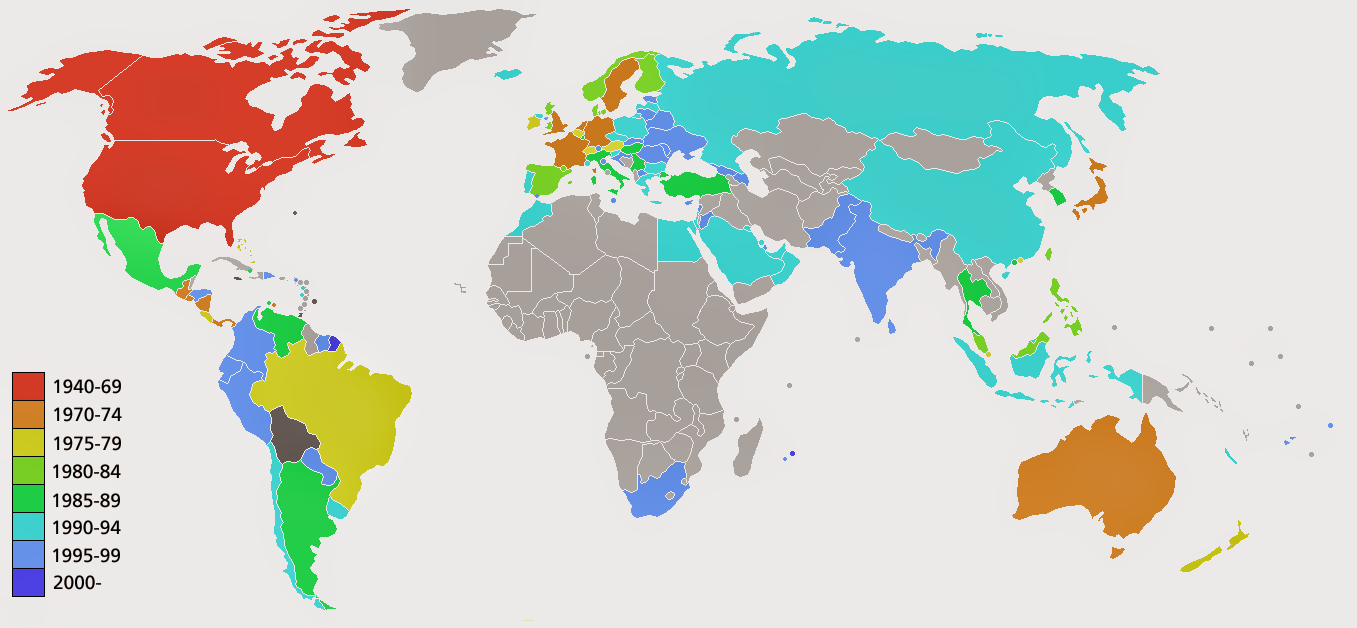
Some might argue that in order to truly get off the beaten track, you must travel to locations without a McDonalds. On the map below, that would be all the grey areas, which now are mainly limited to Central Asian and African countries (with a few other examples spread around the globe).
It is probably not surprising that those grey countries also generally have little western tourism, lending value to my hypothesis that people are afraid to travel and when they do, they'll seek out familiar locations first.

On a similar note, I once read an article somewhere saying that you could track perpetual war zones and economic development by the lack of Coca Cola production plants. Perpetual war zones tend to occur in neglected places (at least neglected from a media or international development perspective) and also tend to be countries with lower values on the Human Development Index (HDI; map below modified from a Wikipedia image).
I think for a lot of Americans, there is a "NIMBY" perspective (not in my back yard), meaning that countries with little cultural similarity and countries that are particularly poor (without mineral values) are neglected. Private companies tend to take over the role of governments (regarding international development) when large mineral or natural resources concessions seem available (examples include DR Congo, Nigeria, Angola, Sudan, Iraq).

When you combine a lack of McDonalds, Starbucks, or Coca Cola with a low HDI, long-term international neglect, and perpetual conflicts, you tend to get failed states and unstable regimes, neither of which are conducive to tourism. And oddly enough, these are exactly the kinds of places that I want to travel to and "figure out," though as a friend once told me, his Ukranian and Moldovan friends can't figure out their own countries, so how am I supposed to?

And that's a question that concerns me and one that drives me to continue to learn about other cultures from an outsider's perspective. I've been doing it long enough and living overseas for most of the last 14 years, to the point where I feel almost like an outsider in my country of birth. But hey, when there's over 300 countries / territories in the world, exile doesn't feel so lonely.

Thanks for reading,

Robert

Thursday, July 8, 2010

Cool People Profile: Robert Young Pelton

Name: Robert Young Pelton
Age: 55
Nationality: Canada, USA
Profession: Gonzo Journalist, Adventurer, Film Maker, Witness to War
Employer: Self-employed
Email: ryp@comebackalive.com
Quote: "I'm a little different. I find the places that make no fucking sense and that's where I want to go."

Social Networking
1. Black Flag Cafe
2. Facebook

Websites
Come Back Alive
Iraq Slogger

A self-described “witness to war” and “iconoclast,” Robert Young Pelton is perhaps best known for his nearly 1100-page “travel guide” to The World’s Most Dangerous Places. He’s also the creators of the websites “Come Back Alive” (named after a survival guide he wrote, the website hosts digital chapters of the World’s Most Dangerous Places, a travel forum frequented by military types, adventure travelers, and loose screws called the Black Flag Cafe, and links to survival gear and videos of his travels) and “Iraq Slogger” (a news website aimed at accurate and current information about the Iraq occupation). He is the author of the books: The Adventurist; Come Back Alive; The Hunter, Hammer and Heaven: Three Worlds Gone Mad; Fielding’s Borneo; and a slew of articles and films that have “long been free filler for print, radio, Internet, and television journalists.”

According to his own biography in The World’s Most Dangerous Places, he has worked as a “lumberjack, boundary cutter, tunneler, driller, hardware store manager, and blaster’s assistant.” He didn’t “get into” journalism... he just ended up there through following his passions. He never believed that everything you need to know about the world can be spoon fed to you through the media so he decided to start traveling to dangerous places during his vacation time while working a desk job. As he kept traveling and making friends with “insurgents, jihadis, rebels, criminals, terrorists” and narco drug traffickers he found himself in the rarified position of war correspondent. The more he traveled the more his stories became marketable and now he’s a full-time gonzo-style journalist (don’t confuse that with a talking head).

He’s survived a “a plane crash, car accidents, a head-on motorcycle crash, killer bees, typhoons, SCUD [missile] attacks, a host of wild animal attacks, Marxist rebels, Russian gunships, Northern Alliance artillery, talib rockets, American B-52s” and being kidnapped by paramilitary drug traffickers in the DariĆ©n Gap of Colombia.

His travels and contacts often allow him “firsts” in journalism. He was with rebels during the attacks on Grozny, Chechnya a decade ago. In his words he “was in the bunkers with the ‘terrorists,’ eating pumpkin pancakes and wondering why the media didn’t give a damn about ‘another war in Europe,’ ethnic cleansing, or even the civilian deaths that happened every day.” He found and saved the life of John Walker Lindh at the Qala-e-Janghi prison in northern Afghanistan in those heady days following 9/11/01.

And perhaps coolest of all, Robert Young Pelton shares all information in a very cynical, pragmatic, and humorous light. Frequently witnessing death as well as courage on far-flung battlefields has made him comment that he “hates war and respects soldiers.” He somehow makes you wish you were there too, which is saying a lot about a war zone.

Monday, June 21, 2010

Why I Travel Around the World

I've always been keen to explore the world. About 5 years back I heard a frightening statistic about the travel habits of Americans. I don't have the reference, so I'm just going on my memory, though I'll try to find updated facts. Basically, I read that most Americans die within 50 miles of their birthplace. Something like only 1 in 4 Americans had passports and of those 25% that did, only about 1 in 6 went anywhere beyond Canada, Mexico, or the Caribbean. Of those 4% of Americans that did travel somewhere beyond the above choices, most went on a once-in-a-lifetime trip to western Europe (usually London or Paris).

I'm sure that the statistics have changed as international travel becomes more common. Also, many would say that the US is a very large and diverse country with many geographical features. I think this is true and keeps some people from "needing" to travel beyond the borders of the US. However, I think that Americans are generally xenophobic (afraid of the unknown and foreign cultures). Nevertheless, Americans are becoming more adventurous, which can be seen in the surge in "ethnic" restaurants over the last decade.

I've been living mostly overseas since 1996 so I've definitely noticed (since arriving back in the continental US in May 2010) that there are more Asian food choices available. Also, the "animosity" I've generally felt towards vegetarianism has really subsided, though vegans will still find difficulty eating out. I remember an old episode of Growing Pains, where Amanda Peet had a minor role as the vegetarian girlfriend of Kirk Cameron. The mother brought out grass on a plate to the table, which was funny to a lot of people but also exemplified the resentment to the strange that I believe is a hallmark of American culture. Americans have always been resistant to outside immigrants and those that assimilate quickest often have to deal with a variety of idiotic remarks.

I grew up in the Midwest USA just north of the greater Chicagoland area. When I visited my family with my long-time Chinese American partner at the time, I remember an uncle remarking: "I can speak a little Asian" as if Asian were a language and that all Asian countries were like different states in the US and everyone could communicate with different accents. He then proceeded to count to ten in Japanese, to which my partner just replied "that's nice, good for you!" For anyone who'd like to learn more about contemporary Asian-American culture so you can respond to comments like that with clever anecdotes, I highly recommend Giant Robot Magazine, which deals with Asian American pop culture and art.

I've made my own share of stupid remarks, I'm sure, but I've tried to approach cultures with an open mind and believe in learning through first-hand experience rather than just the assimilated versions of immigrant communities and 2nd generation (and beyond) children of immigrants. Hence my obsession with travel.

My first round-the-world (RTW) ticket was in 2004. I traveled on a Star Alliance RTW ticket booked through United Airlines, plus added regional flights using Air Asia (I think it is the greatest and safest low-cost airline in Asia) and Continental Micronesia. My flight route looked like this:

In code, the above trip looked like this: MKE-ORD-IAD-PWM-iad-BOS-iad-CHS-iad-FLL-iad-CAE-iad-SAV-iad-LGA-iad-FLL-iad-ORD-IAD-LAX-hnl-LIH-HNL-LAX-IAD-EWR-iad-ORD-IAD-ORD-IAD-ORD-den-lax-HNL-NRT-icn-SPN-GUM-KIX-HKG-SIN-KUL-MES-CGK-DPS...Nusa Lembonggan...DPS-GUM-NRT-SIN...KUL-BKK...REP, BKK, USM...BKK-khi-MCT-DXB-fra-CAI...ALY, LXR...CAI-VIE-CDG-LHR...CWL, PME...lhr-man-ORD-HNL-GUM.

Key to the above:
Capital letters = Airport Codes of stopover cities
Lowercase letters = Layovers but not stopovers
Bold letters = Stopovers greater than 2 weeks
Dashes (-) = Flights between locations
Elipses (...) = Overland travel between locations

For those who don't know airport codes, I travelled the following route: Milwaukee WI USA - Chicago IL USA - Washington DC USA - Portland ME USA - (layover DC) - Boston MA USA - (layover DC) - Charleston SC USA - (layover DC) - Fort Lauderdale FL USA - (layover DC) - Columbia SC USA - (layover DC) - Savannah GA USA - (layover DC) - New York NY USA - (layover DC) - Fort Lauderdale FL USA - (layover DC) - Chicago IL USA - Washington DC USA - Los Angeles CA USA - (layover Honolulu HI USA) - Lihue Kauai HI USA - Honolulu HI USA - Los Angeles CA USA - Washington DC - Newark NJ USA - (layover DC) - Chicago IL USA - Washington DC USA - Chicago IL USA - Washington DC USA - Chicago IL USA - (layover Denver CO USA) - (layover Los Angeles CA USA) - Honolulu HI USA - Tokyo JAPAN - (layover Incheon S KOREA) - Saipan MARIANA ISLANDS - Guam GUAM - Osaka JAPAN - Hong Kong CHINA - Singapore SINGAPORE - Kuala Lumpur MALAYSIA - Medan Sumatra INDONESIA - Jakarta Java INDONESIA - Bali INDONESIA ... Nusa Lembonggan INDONESIA ... Bali INDONESIA - Guam GUAM - Tokyo JAPAN - Singapore SINGAPORE ... Kuala Lumpur MALAYSIA - Bangkok THAILAND ... Siem Reap & Angkor Wat CAMBODIA, Bangkok THAILAND, Koh Samui THAILAND ... Bangkok THAILAND - (layover Karachi PAKISTAN) - Muscat OMAN - Dubai UAE - (layover Frankfurt GERMANY) - Cairo EGYPT ... Alexandria EGYPT, Luxor EGYPT ... Cairo EGYPT - Vienna AUSTRIA - Paris FRANCE - London England UK ... Cardiff Wales UK, Portsmouth England UK ... (layover London England UK) - (layover Manchester England UK) - Chicago IL USA - Honolulu HI USA - Guam GUAM.

Obviously a very complicated first RTW trip with multiple tickets used to maximize miles, bonuses, cheap airfares (in-and-out of Washington DC USA at the time), and diverse interests. With such a complicated ticket it must have been really expensive, right? No... actually through multiple bonuses the total cost of all tickets used for the above itinerary was just over US$2800, taxes included. Total mileage gained? Over 80,000 miles after bonuses, enough for multiple free tickets later. And in fact, I did about 1.5 times around the world, since I started in Chicago IL USA and ended in Guam.

Over the coming months I'll share some of the tips I've used for constructing such itineraries. I'll post some pictures as well and BRIEF travelogues for each of the countries visited. I'll give plenty of resources, though a great place to start would be the FlyerTalk forum and the nifty online RTW ticket builder that the One World airline alliance puts out, even if you choose you'd rather use another alliance for your tickets.

I'll also discuss my upcoming plans for another RTW trip that I'm planning for late 2010 or early 2011, which I'll be taking to visit all my friends around the world (21 stops in I think 18 countries at last count). If anyone wants to know more specifics (though I think I've provided a lot), let me know by email.

Thanks for reading!

Robert